





How to Save Money on Home Interiors Without Making Them Look Cheap

Smart ways to control your interior budget without compromising on style, comfort or quality
Read time: 6 min
Saving money on interiors doesn’t mean choosing the cheapest laminate, buying less furniture, or removing every design detail.
The smarter approach is to understand where your money creates the most visual and functional impact.
A well-designed home can look premium without having a premium price tag everywhere.
The secret is simple:
Spend more where people notice and use it. Save where they don’t.
Here are practical ways to do it.
1. Don’t Make Every Wall a Feature Wall

One of the easiest ways to increase an interior budget is to treat every wall as a feature.
Stone. Fluted panels. Wallpaper. Wood. CNC patterns. PU panelling.
Using all of them throughout the home can quickly become expensive — and visually overwhelming.
Instead, choose one or two hero areas.
For example:
TV wall in the living room
Bed-back wall in the master bedroom
Kitchen backsplash
Entrance wall
Keep the remaining walls simple.
One beautiful feature wall can create more impact than five average ones.
2. Use Premium Materials Strategically
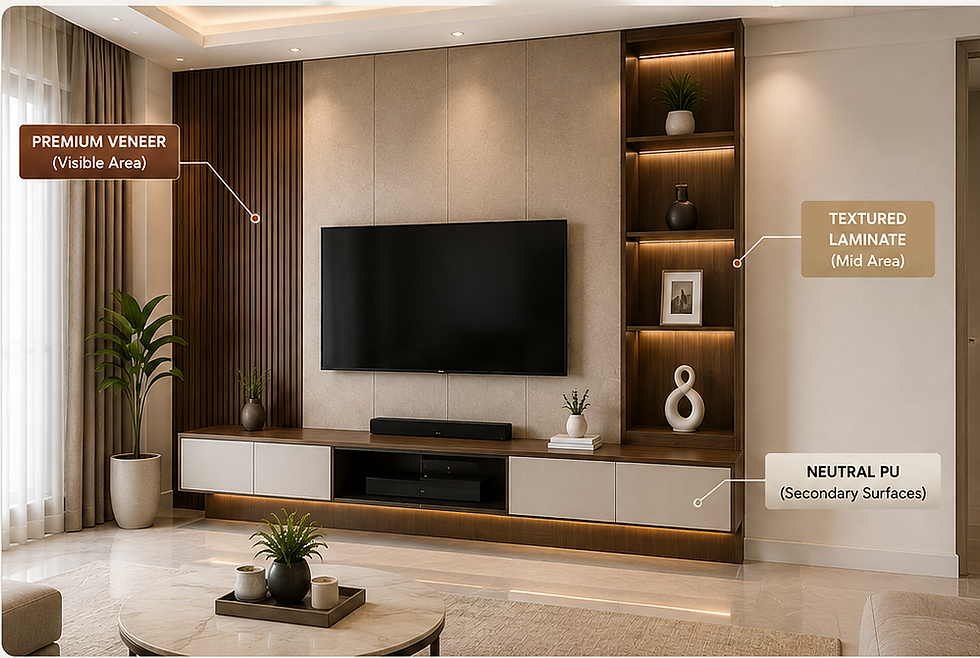
You don’t need premium materials everywhere.
Instead of using expensive veneer across an entire TV unit, use it on the most visible sections and combine it with a good-quality laminate.
For example:
Premium veneer + textured laminate + neutral PU
can create a sophisticated combination without making every surface expensive.
This is called material hierarchy.
Not every element needs to be the star.
3. Spend More on Hardware Than You Think

Hardware isn’t always visible, but you interact with it every day.
Kitchen drawers.
Wardrobes.
Storage units.
Soft-close mechanisms.
Hinges.
Channels.
Instead of upgrading every decorative surface, consider investing in good hardware where it receives heavy use.
A cabinet with a beautiful finish but poor hardware won’t feel premium for long.
4. Keep the Ceiling Simple

A complicated false ceiling can add considerable cost.
Multiple levels, curves, decorative profiles and excessive lighting can quickly increase both material and labour costs.
A simpler solution can often look more sophisticated:
Clean recessed borders
Cove lighting
Linear profiles
Carefully positioned downlights
Minimal ceiling detailing
Luxury doesn’t require a complicated ceiling.
It requires good proportions and lighting.
5. Invest in Lighting Instead of Decoration

One of the most cost-effective ways to improve an interior is lighting.
Instead of spending heavily on decorative objects, focus on:
Warm ambient lighting
Cove lighting
Cabinet lighting
Wall washers
Bedside lights
Pendant lights
Good lighting can make affordable materials look considerably better.
Poor lighting can make expensive materials look ordinary.
6. Choose Furniture Carefully

You don’t need custom furniture everywhere.
Use a combination of:
Custom pieces for areas where exact proportions matter.
Ready-made furniture where standard sizes work well.
For example, a custom TV console may be worth the investment because it needs to fit the wall precisely.
But a side table or accent chair doesn’t necessarily need to be custom-made.
Mixing custom and ready-made furniture can save a significant amount.
7. Don’t Overbuild Storage

More storage isn’t automatically better.
Before adding another cabinet, ask:
What exactly will I store here?
Poorly planned storage can consume valuable floor area and budget.
Instead:
Use full-height storage where appropriate
Add drawers where they genuinely help
Use internal organizers strategically
Avoid unnecessary decorative cabinets
Design storage around actual belongings
Good storage is about efficiency, not quantity.
8. Standardize Materials

Using too many different finishes increases both cost and visual complexity.
Instead, select a controlled palette.
For example:
Warm ivory + walnut + beige + brushed brass
Then repeat these materials across different rooms.
The same wood finish can appear in:
Living room
Dining area
Bedroom
Study
This creates continuity while reducing the number of materials you need to source.
And it makes the home feel more thoughtfully designed.
9. Use Wallpaper Where It Makes Sense

Wallpaper can sometimes create the visual impact of expensive wall treatment at a lower cost.
A well-selected textured or botanical wallpaper can transform a bedroom or dining wall without requiring extensive carpentry.
The key is choosing the right location.
Use it as a feature, not everywhere.
10. Don’t Chase Every Trend

Trendy interiors can become expensive because trends encourage constant changes.
Instead of designing around a trend, build the permanent elements around timeless choices:
Neutral flooring
Good-quality wood tones
Simple cabinetry
Classic lighting
Comfortable furniture
Then introduce trends through things that are easy to replace:
Cushions. Artwork. Rugs. Decor. Throws. Accessories.
This keeps your home current without requiring a renovation every few years.
11. Spend More on Things You Touch Every Day

Here’s a simple rule:
Spend more on:
Sofa
Mattress
Kitchen hardware
Wardrobe hardware
Frequently used fittings
Lighting
High-use surfaces
Save on:
Decorative accessories
Trend-driven finishes
Low-use storage
Excessive wall treatments
Unnecessary ceiling details
Think about frequency of use, not just visual appearance.
12. Don’t Sacrifice Functionality to Save Money
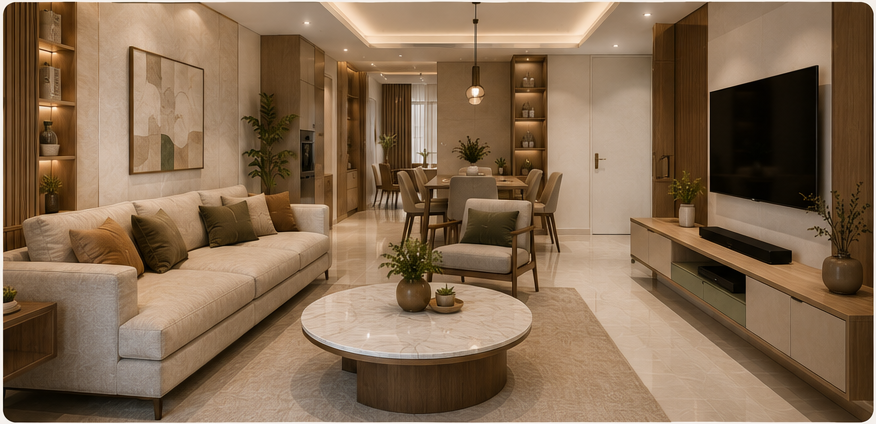
This is where homeowners sometimes go too far.
Removing storage to save money may create clutter later.
Choosing poor kitchen hardware may lead to repairs.
Buying an uncomfortable sofa simply because it’s cheaper isn’t really saving money.
A good budget reduction should remove unnecessary design cost, not essential functionality.
13. Plan Before You Start

The most effective way to save money is surprisingly simple:
Plan properly before execution.
Finalize:
Layout
Furniture sizes
Electrical points
Lighting
Storage
Materials
Colours
Hardware
Appliances
Changing decisions after execution begins can lead to:
Extra material + extra labour + extra time = extra cost.
A little more planning at the beginning can prevent expensive changes later.
14. Think in Terms of Visual Impact

Before spending money on any element, ask:
Will this significantly improve the room?
A ₹50,000 decorative feature that barely changes the room may not be worth it.
But ₹50,000 spent on better lighting, a comfortable sofa or improved kitchen hardware may dramatically improve everyday life.
The best interiors aren’t necessarily the ones with the most expensive elements.
They’re the ones where every element has a purpose.
A Simple Budget Strategy
If you have a fixed budget, divide your priorities into three categories:
MUST HAVE
Things essential for functionality.
Kitchen, wardrobes, storage, electrical and basic lighting.
SHOULD HAVE
Things that improve comfort and appearance.
Custom furniture, feature walls, upgraded hardware and layered lighting.
NICE TO HAVE
Things that can be added later.
Decorative accessories, artwork, smart-home upgrades and additional styling.
This allows you to complete the home properly without overspending at the beginning.
Final Thought

Saving money on interiors doesn’t mean making your home look basic.
It means making smarter design decisions.
Use premium materials selectively.
Keep the ceiling simple.
Invest in good lighting.
Choose furniture carefully.
Prioritize storage.
Standardize your materials.
Avoid unnecessary decoration.
And most importantly, plan before execution.
Because the goal isn’t:
“How can I spend less?”
It’s:
“How can I get the most design value from every rupee I spend?”
That’s how you create a home that feels expensive without being unnecessarily expensive.


Comments